
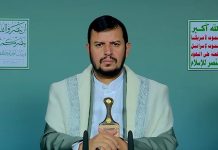





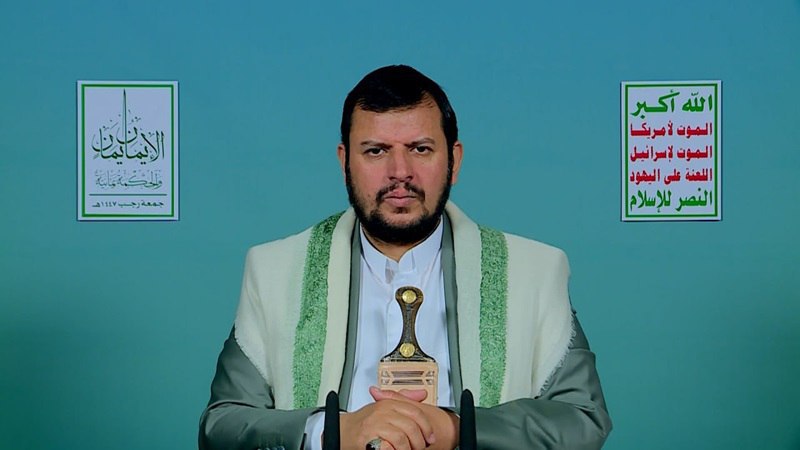
The leader of the revolution, Sayyed Abdulmalik Badr al-Din al-Houthi, congratulated the Yemeni people on the occasion of the Friday of Rajab, which he described as one of the most blessed occasions.
In his address on the occasion, the leader stated that “our people celebrate the Friday of Rajab in appreciation of the blessing of guidance to Islam, which is the greatest of blessings.”
In a comprehensive speech spanning multiple interconnected themes, Sayyed Abdulmalik emphasized the importance of a defensive struggle to preserve Islamic identity against a hegemonic and corrupting Western-Zionist alliance and its regional collaborators.
The leader described Rajab Friday not merely as a time for personal piety, but as an “inspiring milestone” that fortifies the Yemeni people against systematic campaigns targeting their “faith identity and Islamic affiliation.”
He posited Yemen’s historical conversion to Islam as the nation’s definitive and most sacred transformation, establishing a foundational link between Yemeni nationalism and Islamic orthodoxy. This fusion of faith and national identity was presented as the bedrock upon which all resistance is built.
He explicitly identified this “tyrant of the age” as a unified alliance comprising “the Jews, global Zionism, America, Israel, Britain, and their agents and followers.” He characterized this coalition as historically unprecedented in its danger and oppression, explaining that it possesses financial, media, and technological resources “unmatched in human history.”
These resources, he added, are deliberately weaponized to wage a “soft, satanic, corrupting, and misleading war” with the ultimate goal of eviscerating Islamic societies from within. The objectives of this war, according to the leader, are the widespread propagation of moral decay ( munkarat ), the systematic destruction of religious and ethical values, and—most critically—the severing of Muslim populations from their spiritual and intellectual moorings in the Quran.
Sayyed Abdul-Malik warned of a multi-pronged strategy executed through both direct enemy action and the complicity of “client leaders and regimes.” He accused regional governments, notably singling out Saudi Arabia, of active collaboration in this project.
His condemnation of Saudi Arabia was particularly sharp, mentioning that its educational curriculum had been fundamentally compromised, brought under the influence of “Western, Israeli, American standards” that are effectively placed above the authority of the Quran. He added this involved the deletion of specific Quranic verses, the distortion of meanings, and the removal of core concepts like Jihad from school textbooks, representing a “catastrophic blow” to authentic faith identity.
He also pointed to non-governmental organizations and media platforms focusing on youth and women as conduits for “deceptive and attractive slogans” designed to recruit those lacking “intellectual and cultural immunity.” The end goal of all these efforts, he asserted, is to create a “psychological and mental separation” between the Muslim Ummah and the Quran, thereby rendering populations pliant, “domesticated,” and easily controlled by foreign powers.
In response to this existential threat, al-Houthi resurrected and redefined the concept of “Jihad in the path of God.”
He meticulously distinguished this from what he dismissed as mere “formalistic and distorted” versions of military action [like Daesh] that ultimately serve enemy interests.
“True Jihad, in his formulation, is the comprehensive striving to establish divine law, uphold truth, and confront tyranny in all its forms. It is presented as the ultimate litmus test of sincere faith and the essential instrument for protecting the oppressed.”
Elsewhere, the leader of the revolution Sayyed Abdul-Malik al-Houthi issued a stark warning of impending regional escalation, touted Yemen’s military readiness, and launched sweeping condemnations of Arab states normalizing relations with Israel, accusing them of complicity in theft and moral decay.
Call for Heightened Military Readiness and Warning of Coming Conflict
The leader dedicated a significant segment to strategic warnings, asserting that the “Israeli enemy, in American partnership, is preparing for more escalation and future rounds” of conflict.
He pointed to a continuous “air bridge” between the U.S. and Israel, which he affirmed was stockpiling weapons in the region as part of these preparations.
He framed upcoming confrontations as “confirmed rounds,” leaving “no doubt” about their inevitability.
In response, he emphasized the necessity of unceasing “activity, awareness, and preparation,” stating, “We must be in constant work to confront what exists, and prepared for what is coming.”
He praised ongoing domestic mobilization efforts, citing 1,484 marches and vigils by men and 138 by women, alongside armed tribal gatherings, which he described as the “backbone” of Yemeni society expressing “authentic faith-based stance.”
Condemnation of Arab-Israeli Normalization and “Equation of Violation”
A major focus of the speech was a fierce denunciation of Arab states pursuing normalization with the Israeli enemy.
Sayyed Abdul-Malik reserved particularly harsh criticism for Egypt’s natural gas deal with the Israeli enemy, labeling it a “major sin” and a “shameful deal” that involved purchasing “stolen” Palestinian resources.
He extended this critique to the Saudi regime, criticizing its cooperation with the Israeli enemy on cables and communications, and to Jordan regarding water resources.
He accused these governments of accepting an “equation of violation,” a state of affairs where Israeli aggression and “usurpation” become normalized and unchallenged.
He argued that “client regimes” and a “movement of hypocrisy” within the Arab world were working to make this acceptance palatable to their populations, seeking to disarm any meaningful resistance.
Analysis of Regional Conflicts and Accusations of Proxy Warfare:
Regarding the situations in Syria and Lebanon, the leader made it clear that the armed groups in Syria controlled by external patrons (a clear reference to Turkish-backed factions) explicitly do not oppose the Israeli enemy and seek normalization, and thus are allowed to possess weapons only to “incite internal strife,” not to fight the Israeli enemy.
He contrasted this with the Western efforts to disarm Lebanese Hezbollah. This, he explained, reveals the true intent: any Arab military force is acceptable only if it is ultimately subservient to American control and directed inward, not against the Israeli enemy.
He framed this as part of a broader U.S.-Israeli design to dominate the region’s resources, drawing a parallel to American pressure on Venezuela’s oil reserves.
Ideological Core: The Fight for Islamic Identity Against “The Tyrant of the Age”
Sayyed Abdul-Malik defined “the tyrant of the age” as a unified entity of “Jews, global Zionism, America, Israel, Britain, and their agents.”
This tyrant, he said, possesses unprecedented capabilities to spread corruption, dismantle societal values, and wage a “soft, satanic war” aimed at emptying Islamic nations of their faith-based identity.
He presented the Islamic resistance—encompassing military, media, and cultural activities—as the authentic defense of this Quranic identity. The preservation of this “faith identity,” he concluded, is the essential fortification against becoming a “puppet” controlled by foreign powers.
Sayyed Abdul-Malik concluded by reaffirming Yemen’s commitment to the Palestinian cause, boasting that US efforts had failed to stop Yemen’s military operations in support of Gaza before the ceasefire and vowing they would not succeed in doing so in the future.
He characterized the Yemeni Armed Forces’ weapons as being “in the hands of a nation relying on God,” framing their continued resistance as an inevitable, principled, and divinely-supported trajectory.