








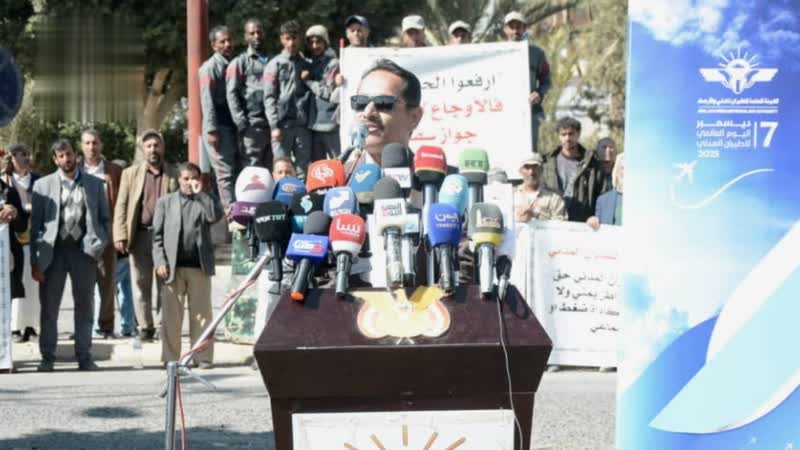
The Republic of Yemen marked International Civil Aviation Day with a protest and press conference at Sana’a International Airport, organized by sectors of aviation, health, and the National Human Rights Authority, highlighting the continued blockade imposed on Yemen and its devastating humanitarian consequences.
During the event, speakers stressed that Sana’a International Airport is a critical lifeline for civilians in need of medical evacuation and for the smooth functioning of civil aviation. However, the airport remains closed due to prolonged restrictions enforced by the US-Saudi aggression.
In a joint statement, the Civil Aviation and Meteorology Authority, the National Human Rights Authority, and the Ministry of Health and Environment strongly condemned the aggressive states’ targeting, bombing, and full blockade of Sana’a Airport, describing it as a blatant violation of international law, including the UN Charter, the Geneva Conventions, international humanitarian law, the Universal Declaration of Human Rights, and the 1944 Chicago Convention governing civil aviation.
The statement emphasized that the continued arbitrary restrictions on Sana’a Airport represent one of the world’s most severe yet largely unacknowledged humanitarian tragedies. The airport’s shutdown has become a symbol of widespread suffering, resulting in thousands of deaths and the worsening of social and humanitarian crises.
According to official figures cited in the statement, more than 1.5 million patients have died due to the inability to access medicines previously brought in through Sana’a Airport. An additional 125,000 patients died because they were unable to travel abroad for treatment, while more than 250,000 patients now urgently require travel for life-saving medical care. The import of medical supplies has dropped by 60 percent.
The statement also noted severe damage to key civilian sectors linked to aviation — including health, trade, tourism, and investment — and the prolonged stranding of thousands of Yemenis abroad in dire conditions.
It added that over 80 percent of civil aviation workers have lost their jobs, including approximately 5,000 employees at Sana’a Airport and national airlines. Students on scholarships have been unable to continue their education abroad, and international medical missions have been blocked from entering the country.
The joint statement called for an immediate and unconditional reopening of Sana’a International Airport to regular civilian flights, stressing that access to travel is an inherent human right that cannot be politicized.
It urged an end to all targeting of civilian infrastructure in Yemen, particularly airports, and demanded that all Yemeni airports be reopened to alleviate the humanitarian crisis caused by the blockade.
The statement also called on the United Nations and the international community to take a clear position against the coalition’s destruction of Yemeni civilian airports and aircraft, and urged the International Civil Aviation Organization (ICAO) to fulfill its legal obligations by intervening to lift the restrictions on Sana’a Airport.
It further urged the UN, the Security Council, and specialized international organizations to uphold international humanitarian and human rights law, enforce the Chicago Convention’s provisions that prohibit attacks on civilian airports, and issue a binding international resolution for the reconstruction of Yemen’s civilian airports.
It also called for the deployment of an international investigation team to document the targeting of civil aviation infrastructure.
The statement concluded by reaffirming Yemen’s commitment to professional, ICAO-compliant management of its airports and its adherence to national and humanitarian responsibilities in serving civil aviation.