









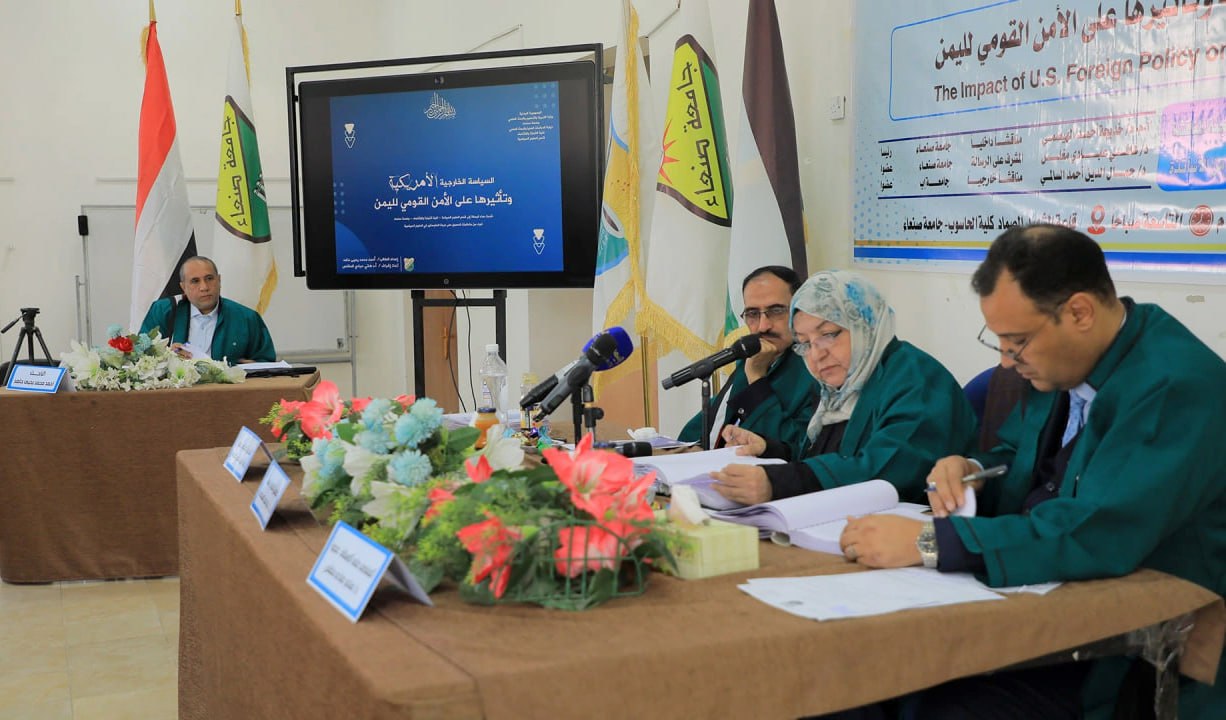
Researcher Ahmed Mohammed Yahya Hamed obtained on Sunday a Master’s degree with an Excellent grade with Honors, from the Department of Political Science at the Faculty of Commerce and Economics, Sana’a University, for his thesis entitled “U.S. Foreign Policy and Its Impact on Yemeni National Security.”
The discussion and examination committee was formed under the chairmanship of Dr. Khadija al-Haisami as internal examiner from Sana’a University, with the membership of Dr. Hani Mughles as scientific supervisor from Sana’a University, and Dr. Jamal al-Din al-Salmi as external examiner from Ibb University.
The study aimed to know the impact of U.S. foreign policy on Yemen’s national security, in its dimensions “military, political, economic, cultural, and social” during the period 2001–2025, through identifying the determinants that affect U.S. foreign policy, diagnosing the nature of American interests, clarifying the strategies and slogans it raised to achieve those interests in the Arab region, knowing the hidden objectives of U.S. foreign policy therein and its methods of implementation in general, and knowing the determinants and objectives of U.S. foreign policy toward Yemen and its implementation tools.
It also aimed to know the concept of Yemen’s national security, clarify its dimensions, and diagnose the American threats facing Yemen’s national security as a result of U.S. foreign policy.
The importance of the study at the scientific level lies in its focus on an important historical era full of events and challenges extending from “2001 to 2025,” and its addressing of a political issue among the very important and extremely dangerous issues that occupy many political and cultural elites in Yemen and the Arab and Islamic countries.
In this study, the national interest approach and the case study approach were used in addressing the impact of U.S. foreign policy on Yemen’s national security. The content analysis tool was also used to interpret many American statements and positions on events and developments during the study period.
The study reached several results, most notably that U.S. foreign policy affected Yemen’s national security in its dimensions “military, political, economic, cultural, and social” during the same period, and had a large and catastrophic impact on the military and security dimension of national security, through committing killing crimes against citizens in the unjust wars on Saada Governorate, passing through the crimes of aggression against Yemen in 2015, up to the crimes of direct U.S. aggression in 2023 and 2025, violating national sovereignty and militarily violating Yemen under the pretext of combating what is called terrorism in Yemen, and the weakness of the Yemeni army in deterring external aggression against Yemen, through stripping the Yemeni army of military power, dismantling it, weakening it, and destroying all its capabilities.
The study results indicated the impact of U.S. foreign policy on the political dimension of national security, through imposing American guardianship over the political decision in Yemen, installing an illegitimate president of the state in 2012 outside the framework of the constitution and popular and revolutionary support, who brought external aggression upon his country and people, and the occurrence of major fractures and wide splits within the Yemeni political components.
According to the study results, U.S. foreign policy had an impact on the economic dimension of national security through targeting the Yemeni economy in the period “2000–2014” by implementing the economic reform program that succeeded in increasing Yemen’s integration into the global capitalist economy, and caused a decline in the value of the national currency, lifting subsidies on basic commodities and oil derivatives, and the weakness of the Yemeni economy in the period “2015–2025.” Among those impacts were the decline in the rate of public state revenues, duality of monetary policy, collapse of the value of the national currency, targeting and destruction of infrastructure, leading to rising poverty rates and deterioration of the living standard.
The study also concluded that U.S. foreign policy affected the social dimension of Yemen’s national security through the disintegration of the social fabric of Yemeni society as a result of the unjust wars on Saada Governorate, the growth of secessionist calls in the southern governorates, and the entrenchment of a culture of hatred and revenge, which deepened the rift in the Yemeni social fabric and the emergence of a deep crisis in the sense of inclusive national identity, in addition to the impact of U.S. foreign policy on the cultural dimension of Yemen’s national security through the deterioration of the educational process, emptying basic education of its content, and mining the future of generations by distorting educational curricula according to objectives of an American character.
The discussion was attended by a number of rectors of public and private universities, academics, students, researchers at Sana’a University, and the researcher’s colleagues and relatives.