






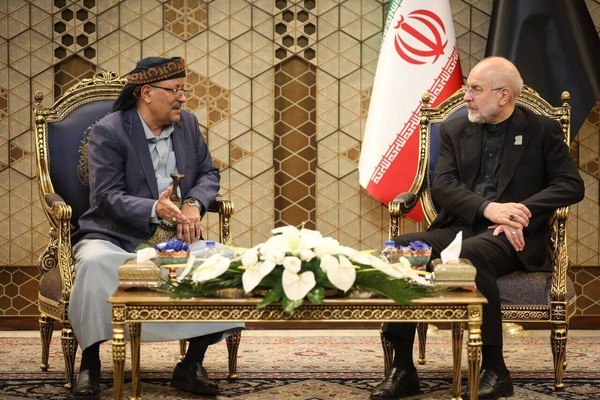
The Speaker of the Islamic Consultative Assembly of Iran, Mohammad Bagher Ghalibaf, praised the resistance of the Yemeni people against injustice and economic blockade.
He said: “The Yemeni people have demonstrated their resilience in the face of actions that violate international rules , the injustice of oppressors, and they have provided evidence of the strength of the unified resistance front in economic, military, and political fields,” expressing his appreciation for the presence of the Yemeni delegation at the funeral ceremonies of the martyred leader of the Islamic Revolution.
Ghalibaf stressed during his meeting on Sunday with a member of Yemen’s Supreme Political Council, Mohammad Al-Nuaimi: “We must bring Islamic countries closer together through unity and solidarity,” according to Iran’s Mehr News Agency.
He emphasized that regional security and economic stability can only be achieved through cooperation and coordination among Islamic countries.
Referring to the defeat of the United States and the Israeli entity in the “Ramadan war,” the head of the Iranian negotiation team added: “In the latest memorandum, the United States and Israel were practically forced to acknowledge Iran’s allies in the resistance front. This is one of the achievements of that memorandum. Iran and the resistance front stood together against the United States and Israel, and this memorandum represents a defeat for the United States and an achievement for the resistance front both militarily and politically.”
He affirmed that the condition for serious negotiations is full readiness for war, saying: “If the Americans and the Israeli entity sense even a moment of weakness or decline in our combat resolve, they will resort to war. At the beginning of the Ramadan war, they set nine specific objectives against the Islamic Republic that were supposed to be achieved within a few days; however, by the end of forty days they had achieved none of them, and after mediation requests, they called for a ceasefire.”
Ghalibaf pointed out that some Islamic countries that were under American influence and maintained relations with the Israeli entity have now realized that neither the United States nor Israel can provide them with security or economic stability. Therefore, Islamic countries must be brought closer together through unity and integrity.
Reaffirming Yemen’s central role in the resistance front, the Speaker of the Islamic Consultative Assembly stated: “Yemen and the Yemeni people have always stood with the resistance, defending Gaza, Lebanon, and Palestine in all hardships. The Yemeni people have shown all countries that aligned themselves with America and Israel that they chose the wrong path.”
In response, Mohammad Al-Nuaimi expressed condolences over the martyrdom of the leader of the Islamic Revolution and conveyed the greetings of the revolution leader, Sayyid Abdul-Malik Badr al-Din al-Houthi, saying: “We and you are in one trench, standing together for the Islamic nation. Our leader has emphasized that standing with the Islamic Republic of Iran is a duty for all of us, and we must draw inspiration from the blood of the martyred leader, just as we draw inspiration from the blood of the Master of Martyrs (peace be upon him), in the spirit of struggle and resistance.”
He added, stressing the importance of maintaining the unity of the resistance front: “What happened in Iran during the recent war has become a school for all resistance fronts, and Iran’s political moves have also provided valuable lessons.”
In conclusion, Al-Nuaimi pointed to the concerning role of some Islamic countries, saying: “While we support cooperation with Islamic countries, the negative and regressive actions of some of these countries are a cause for concern. We are ready for any diplomatic cooperation, and if diplomatic efforts fail, we are fully prepared to take defensive measures.”