





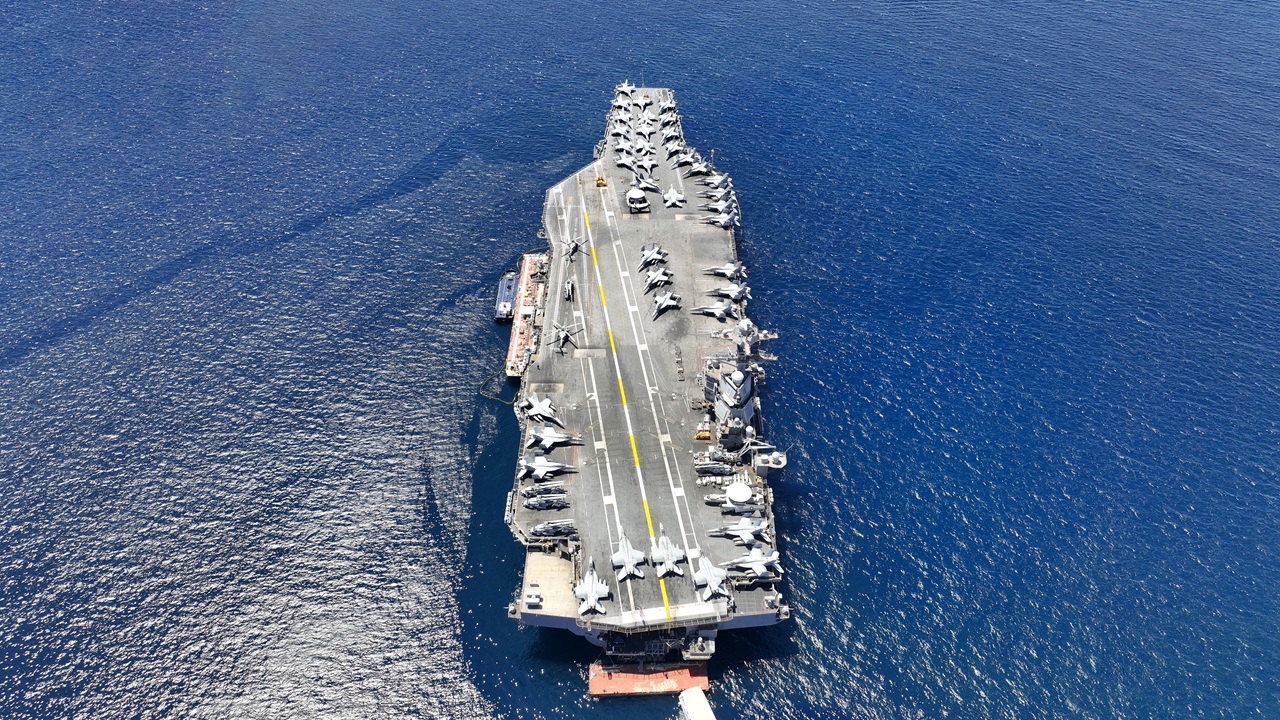
American media outlets recently published footage revealing extensive damage to the U.S. aircraft carrier USS Gerald R. Ford caused by a fire that reportedly broke out following Iranian attacks during the recent war.
CNN released footage showing major damage caused by a fire aboard the world’s largest aircraft carrier in March while it was participating in U.S. military operations against Iran.
In addition to the fire, sources stated that the ship’s firefighting system failed, allowing the blaze to spread and causing widespread damage to the carrier. According to CNN, the losses appear far greater than what had initially been presented to the public.
Sources said these losses also reflect the extent of damage suffered by the United States during its campaign against Iran.
In March, the U.S. Navy issued a brief statement saying the fire had been “contained,” that two sailors received treatment for non-life-threatening injuries, and that the aircraft carrier was “fully operational.”
However, new footage obtained by CNN reportedly shows that the fire was far more serious and destructive than the Navy initially suggested.
One sailor said he was in a situation of “fight or die,” describing his efforts to extinguish the fire aboard the vessel.
The footage showed sailors’ sleeping quarters completely destroyed, leaving behind only charred and twisted metal beneath ceilings that also appeared heavily damaged by the fire.
Wires hung from the ceiling while piles of ash covered the floor around the bunks, according to the video.
The fire took approximately 30 hours to extinguish and involved the entire crew of around 4,500 personnel. Nearly 600 sailors lost access to their sleeping quarters due to the damage. One sailor said: “I seriously thought we were going to lose the ship.”
According to both a sailor and a senior U.S. official familiar with the incident, the ship’s fire suppression system failed, leaving sailors scrambling to contain the flames.
The official told CNN that the Navy’s public statement downplayed the impact the fire had on the Ford while it was deployed in the Red Sea supporting U.S. operations against Iran. The fire reportedly affected operational capabilities, and it took two days before flight operations resumed. Temporary repairs were later carried out at a port in Greece.
Asked about the size of the fire and the failure of the firefighting system, a Navy spokesperson told CNN that the investigation remains ongoing.
The $13 billion carrier played a central role in operations against Iran, with pilots aboard launching repeated combat missions.
A sailor interviewed by CNN recalled seeing an orange streak across the sky in the Red Sea as Iranian munitions appeared on the horizon. He said that when Iranian missiles or drones approached a certain range, the ship would sound alarms warning of an imminent strike and instruct personnel to initiate damage control procedures.
The fire was not the only problem faced during the ship’s standard 11-month deployment. Sailors also reported repeated plumbing failures.
One sailor said: “If you were at the front of the ship, you had to walk all the way to the back to find a working bathroom.”
A military source commented that these losses represent only a fraction of what U.S. forces allegedly suffered from Iranian attacks and claimed that future revelations would show the scale of the defeat suffered during the 40-day war.
Earlier Friday, the Iranian military announced it had launched warning missiles and drones toward two U.S. destroyers in the Gulf of Oman, accusing them of maritime harassment.
In a statement published by the Fars News Agency, the Iranian military said that after launching warning Qader missiles and deploying new Shahed Dana attack drones, the two American destroyers, DDG-103 and DDG-87, left the Gulf of Oman heading toward the Indian Ocean.
The report also states that on February 28, the United States and Israel launched a new military campaign against Iran that lasted 40 days, causing thousands of civilian casualties and targeting schools, hospitals, mosques, and other infrastructure.
In response, Iran reportedly launched Operation True Promise 4 against Israel and U.S. bases in the region.