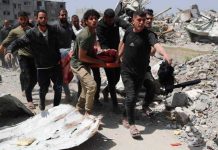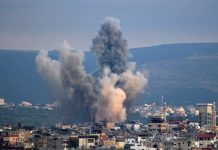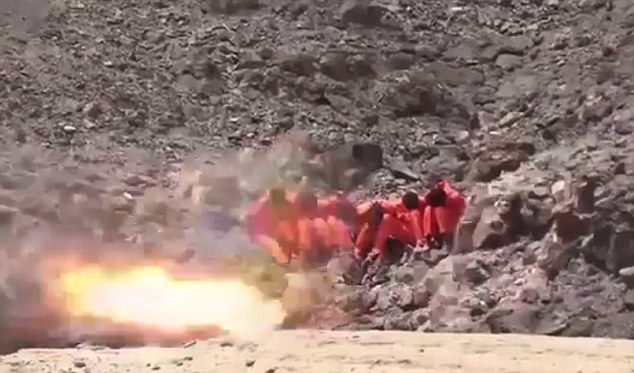







This was stated by UNICEF spokesman James Elder during his video address to journalists in Geneva from Amman, Jordan, on Friday. He confirmed that during this period, “which is supposed to be characterized by restraint and protection, an average of one child has been killed every day for over eight months,” describing this figure as “absurd and horrific,” according to UN News.
Elder pointed out that the children were not killed in a war zone, but “were killed in their homes, in their schools, while playing football or fishing, where they were subjected to gunfire, bombardment, and drone attacks.”
He said: “While the world continues to speak the language of ceasefire, families in Gaza continue to bury their sons and daughters. Yet, if a child is being killed every day, then surely the discussion is no longer about the nature or quality of the ceasefire, but about the credibility of describing the situation as a ceasefire at all.”
These child deaths are part of a toll that includes the martyrdom of more than 1,000 Palestinians and the injury of more than 3,100 others in the Gaza Strip since the ceasefire began, according to the Palestinian Ministry of Health in the Strip.
Elder added: “If one sneezes near the orange line, they may be shot at,” referring to the “continuous creep” of what the Israeli enemy calls occupation boundaries, represented by the “yellow line” and “orange line.”
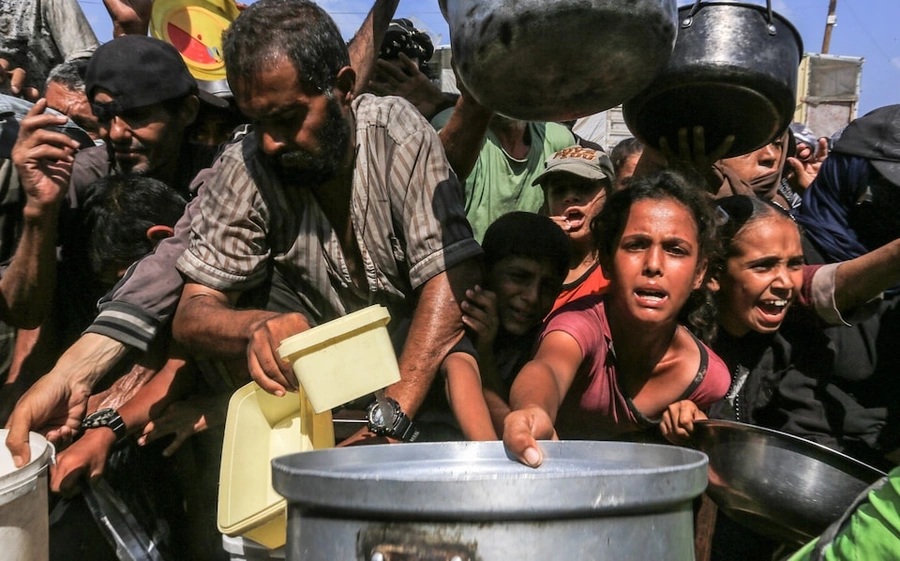
He continued: “I speak to mothers whose children are screaming because there is no clean water to wash themselves. Imagine a father or mother unable to address this situation night after night. The scale of human suffering imposed on Palestinian children in the Gaza Strip is almost unparalleled in our time.”
The UNICEF spokesman painted a complex picture of the energy situation in the Strip, explaining that some fuel has been allowed in to operate some working generators, while oil necessary for their maintenance is barred, as are spare parts needed to repair the many broken generators.
He added: “This is the environment in which my colleagues on the ground are working. They are trying to keep children alive, in the complete absence of the most basic elements of dignity.”
Elder affirmed that the continued killing of children in Gaza “is not the result of a lack of options, but rather the result of a lack of political will.”
He added: “Every day that passes without accountability sends the same message: Palestinian children’s lives can be ended with impunity. It is no longer a malfunction of the system; it has become the system itself.”
For his part, the spokesperson for the UN Office for the Coordination of Humanitarian Affairs (OCHA), Jens Laerke, pointed to other major problems that remain unresolved in the Gaza Strip due to the delay or prevention of aid access, most notably the accumulation of vast amounts of solid waste.
He told journalists in Geneva: “We have all heard the stories about the spread of rats, insects, and so on as a result of this situation. There is an opportunity and a possibility to dispose of all of that, but we are not getting the access to do so.”
With American and European support, the Israeli enemy army has, for more than two consecutive years since October 7, 2023, committed genocide, siege, and starvation crimes in the Gaza Strip, resulting in the martyrdom of 73,018 Palestinian civilians, the majority of them children and women, and the injury of 173,273 others, as of Thursday, in a non-final tally, with thousands of victims still under the rubble and on the roads unreachable by ambulance and rescue crews.
On Thursday, the Palestinian Ministry of Health in the Gaza Strip announced that the total number of martyrs by enemy army fire since the ceasefire on October 10 of last year has reached 1,007, and the total injuries 3,165, in flagrant violation of the ceasefire agreement.
The ceasefire agreement in the Gaza Strip came into effect on October 10 of last year, after a Zionist genocide war that lasted more than two consecutive years, but the Israeli enemy army continues to commit daily violations of the agreement and still prevents the entry of the majority of humanitarian aid into the Strip.