







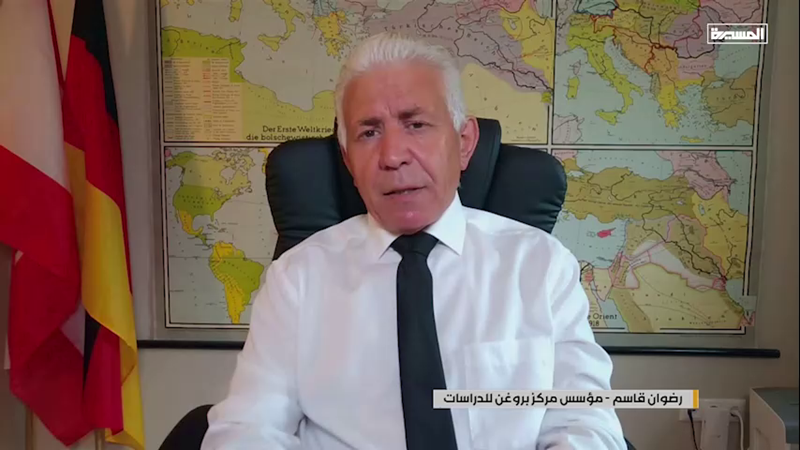
Radwan Qassem, founder and president of the Brogen Center for Studies, said the recent Saudi attack on Sana’a International Airport was an attempt by Riyadh to reassert its role in the emerging regional landscape. However, he said Yemen’s mass rallies and the public response to the call of the leader of the revolution, Sayyed Abdulmalik al-Houthi, altered the equation and delivered a direct message to Washington before reaching Saudi Arabia.
Speaking to Al Masirah TV, Qassem said developments in the region must be viewed within the broader regional power struggle, arguing that a new geopolitical reality is taking shape and that actors excluded from it risk losing influence over the region’s future.
He described the current confrontation as one between the United States and its allies on one side and Iran and its allies in the Axis of Resistance on the other, adding that Saudi Arabia and other Gulf states have found themselves increasingly marginalized, with Washington reserving a central role primarily for the Zionist entity.
Qassem argued that Riyadh sought through its strike on Sana’a Airport to demonstrate that it remained an indispensable regional actor whose participation was necessary in any future regional arrangements or understandings involving Iran and the United States. He maintained, however, that Washington had no intention of granting Saudi Arabia such a role.
He said Yemen’s response—including the large-scale public mobilization and the warnings issued by Sayyed Abdulmalik al-Houthi—caught many observers by surprise, diminishing Saudi Arabia’s regional role and signaling that Yemen would not allow external powers to shape its future or that of the wider region.
Qassem further said the developments demonstrated cohesion within the Axis of Resistance, arguing that attempts to divide its members would fail. He added that Yemen had sent a clear message that developments affecting Iran would draw a response from Yemen and vice versa, while asserting that Saudi Arabia had served as a conduit for U.S. messages before Yemen disrupted that dynamic.
He also pointed to what he described as the strong alignment between Yemen’s leadership and its people, saying the unity of political leadership and public support had strengthened Yemen’s position and complicated US policy in the region.
Qassem highlighted Bab al-Mandab as one of Yemen’s key strategic assets, warning that any broader regional escalation affecting the waterway—similar to tensions surrounding the Strait of Hormuz—could have serious consequences for global trade and the international economy.
He said Yemen now possesses two major strategic advantages: broad popular backing, demonstrated through the recent mass rallies, and its strategic location overlooking Bab al-Mandab. According to Qassem, the political message conveyed by the demonstrations reached Washington before Riyadh because other regional actors ultimately operate within the framework of US policy.
He also argued that Gulf governments lack independent decision-making authority, saying Washington retains significant leverage over Saudi Arabia through a range of political and diplomatic tools.
Concluding his remarks, Qassem said Iran and Yemen now hold two strategic levers capable of reshaping regional dynamics and influencing the global economy through the strategic waterways of the Strait of Hormuz and Bab al-Mandab, which he described as critical to international energy supplies and maritime trade.
Qassem’s remarks came after millions of Yemenis participated in nationwide rallies on Friday in response to a call by the leader of the revolution Sayyed Abdulmalik al-Houthi, who urged public demonstrations to reaffirm support for ending the Saudi-led blockade and defending Yemen’s sovereignty.
In his televised address, Sayyed Abdulmalik declared that Yemen would no longer accept the continuation of a policy of blockade and economic pressure, announcing new deterrence formulas including “siege for siege,” “airport for airport,” and “port for port.”
He warned that any comprehensive Saudi escalation would be met with a comprehensive Yemeni response, signaling the end of the de-escalation phase that has largely been in place since 2022 and the beginning of a new stage of confrontation unless the blockade is lifted.