



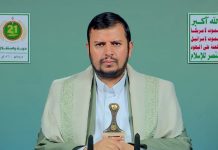







Yemeni scholars have renewed their full support for the leadership’s decisions, represented by Leader of the Revolution Sayyed Abdul-Malik Badr al-Din al-Houthi and the Supreme Political Council, regarding the establishment of the “blockade-for-blockade and escalation-for-escalation” equation.
In a statement issued at the annual conference of Yemeni scholars, held in Sana’a under the title “Yemeni Scholars Confronting Aggression and Blockade,” the scholars described the leadership’s decisions as legitimate and necessary. They cited a number of Quranic verses addressing the right to respond to aggression and support the oppressed.
The scholars called on the governments and peoples of the Muslim world to urge the Saudi regime to return to reason, lift the blockade on Yemen, and end occupation and aggression, describing this as the only path toward peace and good-neighborly relations and the protection of lives, honor, and property across the region.
They stressed that any participation in an alliance against Yemen constitutes aggression that must be confronted through all legitimate means, adding that such measures would not deter the Yemeni people from reclaiming their rights and national resources.
The statement also urged the Saudi regime to learn from the lessons of its previous alliances, which the scholars said had ended in failure and defeat. Instead, they called for any alliance to be directed toward supporting Gaza, Palestine, and Al-Aqsa Mosque, stressing that Yemen would be at the forefront of such efforts.
Yemeni scholars reaffirmed their rejection of the presence of US and foreign military bases in the region and called for their expulsion, describing attacks against such bases as legitimate.
They further stated that allowing Arab and Muslim lands to be used as launchpads for any US or foreign aggression against an Arab or Muslim country constitutes participation in that aggression and alignment with the enemies of Islam.
The scholars warned of a US and Israeli plot to fuel discord among Muslim countries and destabilize regional security and stability. They called on the Muslim world to confront US and Israeli aggression against the countries and peoples of the region, citing several Quranic verses in support of their position.
The statement also called for greater support for the front lines through financial and human resources, urging people to join training and qualification camps, participate in general mobilization programs, and contribute financially. It warned against the “soft” methods of destructive warfare employed by the enemy.
The scholars stressed the prohibition of cooperation and intelligence-sharing with the enemy, while urging those who had been misled or had sided with the enemy to reconsider their positions and return to the correct path, particularly after the exposure of facts and the removal of “masks.” They characterized the current confrontation as a struggle between Islam, disbelief, and hypocrisy.
The Yemeni scholars said the Yemeni people have suffered severe injustice and hardship as a result of more than 11 years of Saudi-US aggression and blockade, which had reached intolerable levels.
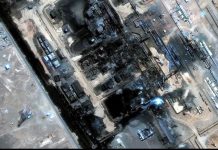
They said the campaign had targeted civilians and infrastructure, including mosques, homes, schools, universities, factories, hospitals, markets, cemeteries, bridges, ports, airports, electricity and fuel stations, media facilities, archaeological sites, food warehouses, telecommunications networks, farms, fishing boats, and gatherings for weddings and funerals in cities and villages.
The scholars also accused the campaign of targeting civilian assets, public-service institutions, government facilities, banks, the economy, and the national currency.
They said the Saudi aggression had also targeted Yemen’s social fabric and fueled divisions among members of the same society, leaving tens of thousands dead and wounded as well as large numbers of orphans and widows.
The statement further accused the Saudi-led campaign of relocating Yemen’s central bank, plundering the country’s resources, and restricting port operations, which it said pushed the Yemeni population toward famine. It also attributed the deaths of tens of thousands of patients to restrictions on air travel.